
Observations & Data
Explore NORVIS observations from the first field campaigns and use the NORVIS Viewer to browse spectra together with their contextual images. Selected datasets will progressively be made available for download.
NORVIS Viewer
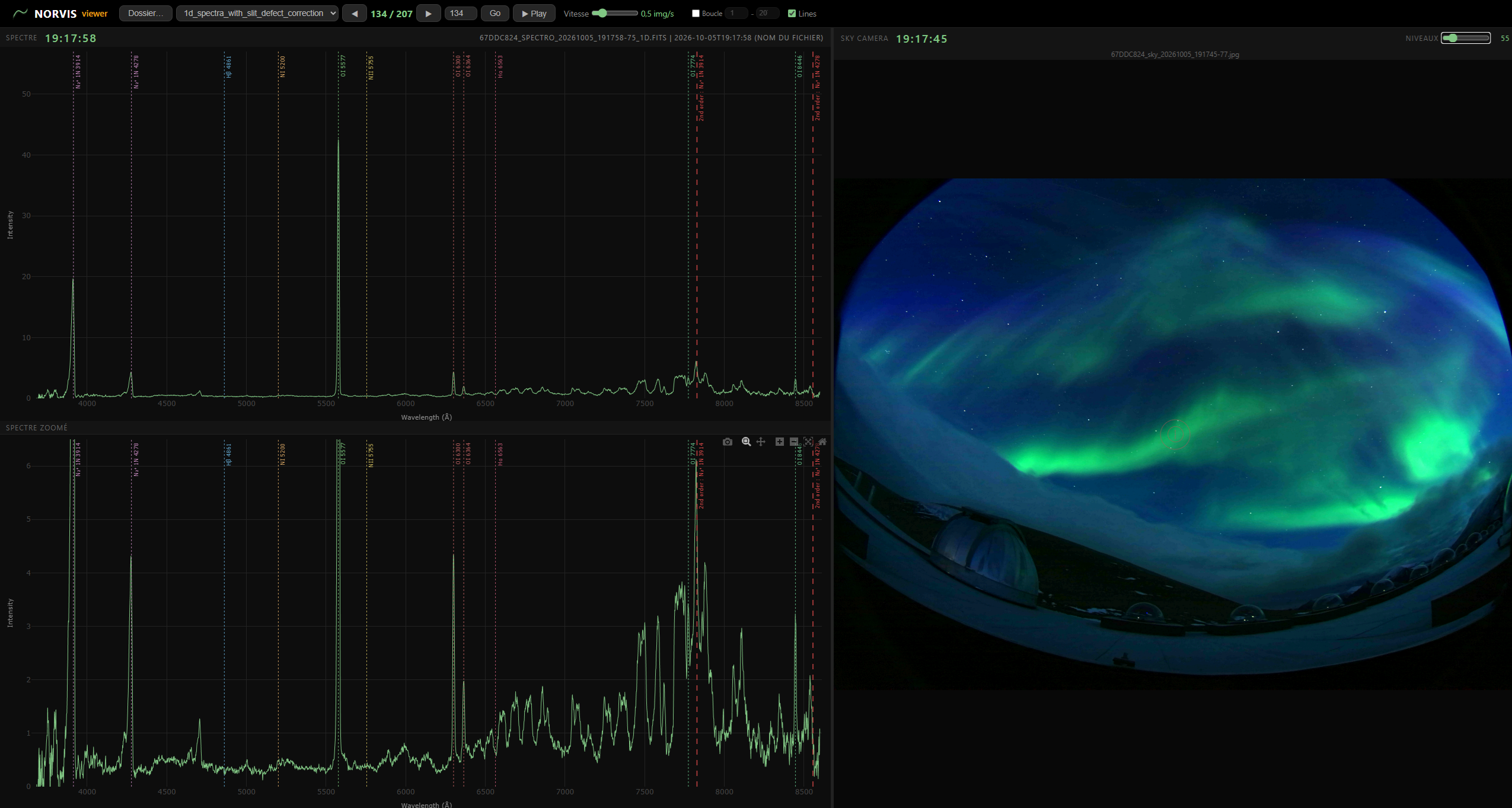
Browse NORVIS spectra and context images
The NORVIS Viewer is a standalone application developed to explore NORVIS observations. It allows spectra to be inspected together with their corresponding contextual images and acquisition information, providing a direct view of the auroral structures associated with each spectroscopic measurement.
The application can be downloaded below. Example datasets compatible with the Viewer will progressively be released with the observing campaigns presented on this page.
February 2026 — Skibotn Observatory, Norway
First NORVIS observing campaign
The first NORVIS field campaign was conducted at Skibotn Observatory in northern Norway in February 2026. It provided the first extended auroral observations obtained with the instrument and was used to validate the complete observing chain under Arctic field conditions.
Over three observing nights, approximately 1,200 spectra were acquired and reduced, with typical exposure times of 30 s. Context images were recorded together with the spectroscopic observations, allowing the instrument pointing to be related directly to the evolving auroral structures in the sky.
The campaign revealed a wide diversity of auroral spectra across the approximately 380–860 nm wavelength range. Major atomic oxygen emissions, molecular nitrogen bands and hydrogen Balmer emissions can be observed within the same spectrum, illustrating the potential of NORVIS for following changes in auroral precipitation and spectral morphology over time.
Broadband auroral spectrum
The example below shows one representative observation from the February campaign. The contextual image identifies the auroral structure sampled by NORVIS, while the simultaneous spectrum shows the corresponding emission signature across the visible and near-infrared range.
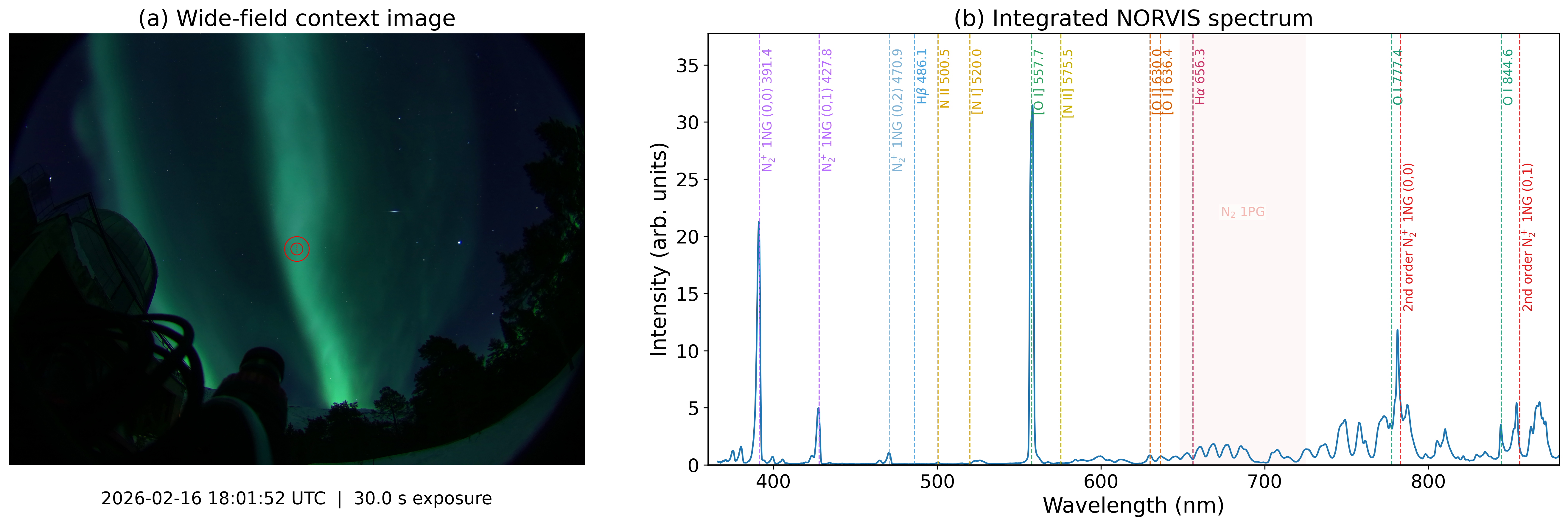
Representative NORVIS observation acquired during the February 2026 campaign at Skibotn Observatory. The spectrum illustrates the simultaneous detection of several atomic and molecular auroral emission systems over the broad NORVIS spectral range.
February 2026 observations
A curated selection of few observations from the February 2026 campaign can be downloaded here. The dataset include NORVIS spectra, their corresponding contextual images and the information required to explore the observations with the NORVIS Viewer.
October 2026 — Kjell Henriksen Observatory, Svalbard
First NORVIS observations from Svalbard
On 5 October 2026, the NORVIS unit installed at the Kjell Henriksen Observatory recorded its first auroral observations. These first-light measurements mark the beginning of NORVIS operations from Svalbard and extend the network to its northernmost observing site.
These observations are still preliminary and are currently being used to verify the instrument configuration, spectral calibration and correspondence between the spectroscopic measurements and the contextual auroral images. They provide the first indication of the spectral conditions that NORVIS will encounter during future high-Arctic observations.
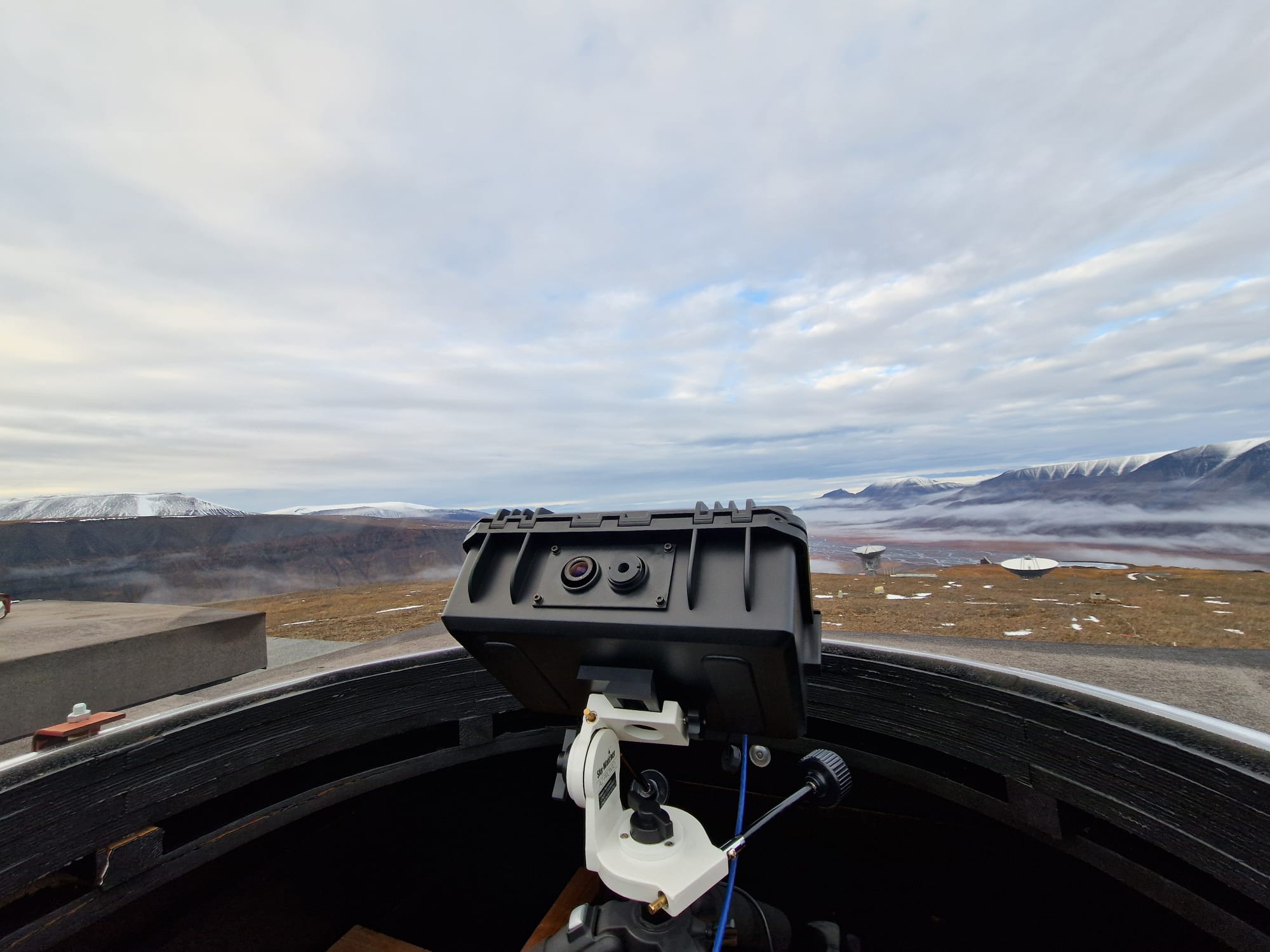
Selected spectrum
The spectrum below is one of the first auroral observations obtained with the KHO instrument on 5 October 2026. These early measurements are shown as first-light data and will be complemented by additional observations as the instrumental setup and processing chain are consolidated.
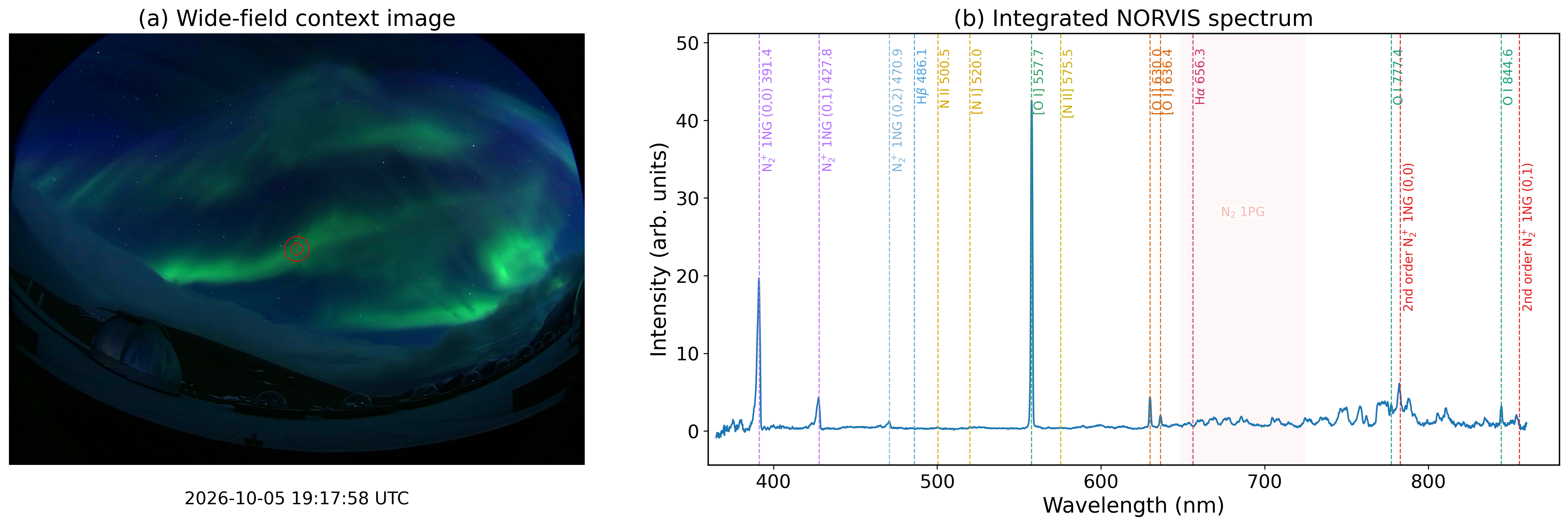
Example first-light NORVIS spectrum obtained at the Kjell Henriksen Observatory, Svalbard, on 5 October 2026. The observation is part of the initial dataset being used to validate the instrument and processing chain at the site.
KHO first observations
A small first-light dataset is currently being prepared. It will contain selected NORVIS spectra together with the corresponding context images and acquisition information, providing an initial example dataset from the Svalbard site.