NORVIS spectrograph
NORVIS is a compact broadband slit spectrograph developed for auroral observations. The instrument combines a science spectrograph with wide-field and slit-context imaging in a portable observing system.
Compact slit spectrograph
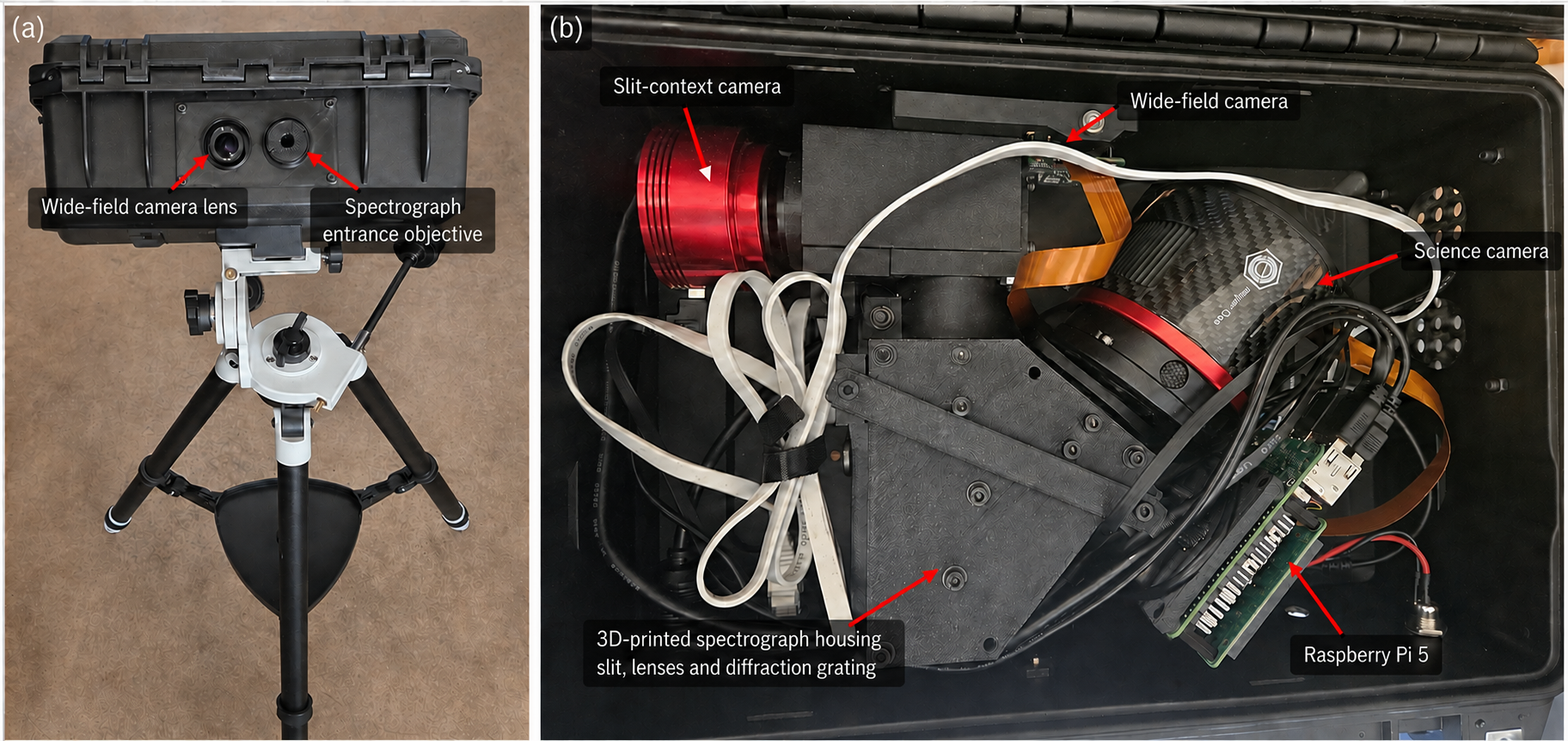
The NORVIS optical assembly is based on a classical slit spectrograph and is integrated in a lightweight 3D-printed enclosure. The same mechanical and optical design can be reproduced for instruments deployed at different observing sites.
In the nominal visible configuration, the instrument covers approximately 380–860 nm in a single acquisition. With the 20 µm entrance slit, the spectral resolution is approximately 1.2 nm FWHM.
NORVIS instrument and internal assembly, including the science camera, slit-context camera, wide-field camera, spectrograph optics and embedded acquisition computer.
Spectrograph optical design
Light from the entrance slit is collimated and dispersed by a 300 grooves mm−1 reflection grating before being imaged onto the science detector. The nominal configuration is centred on the visible auroral spectrum.
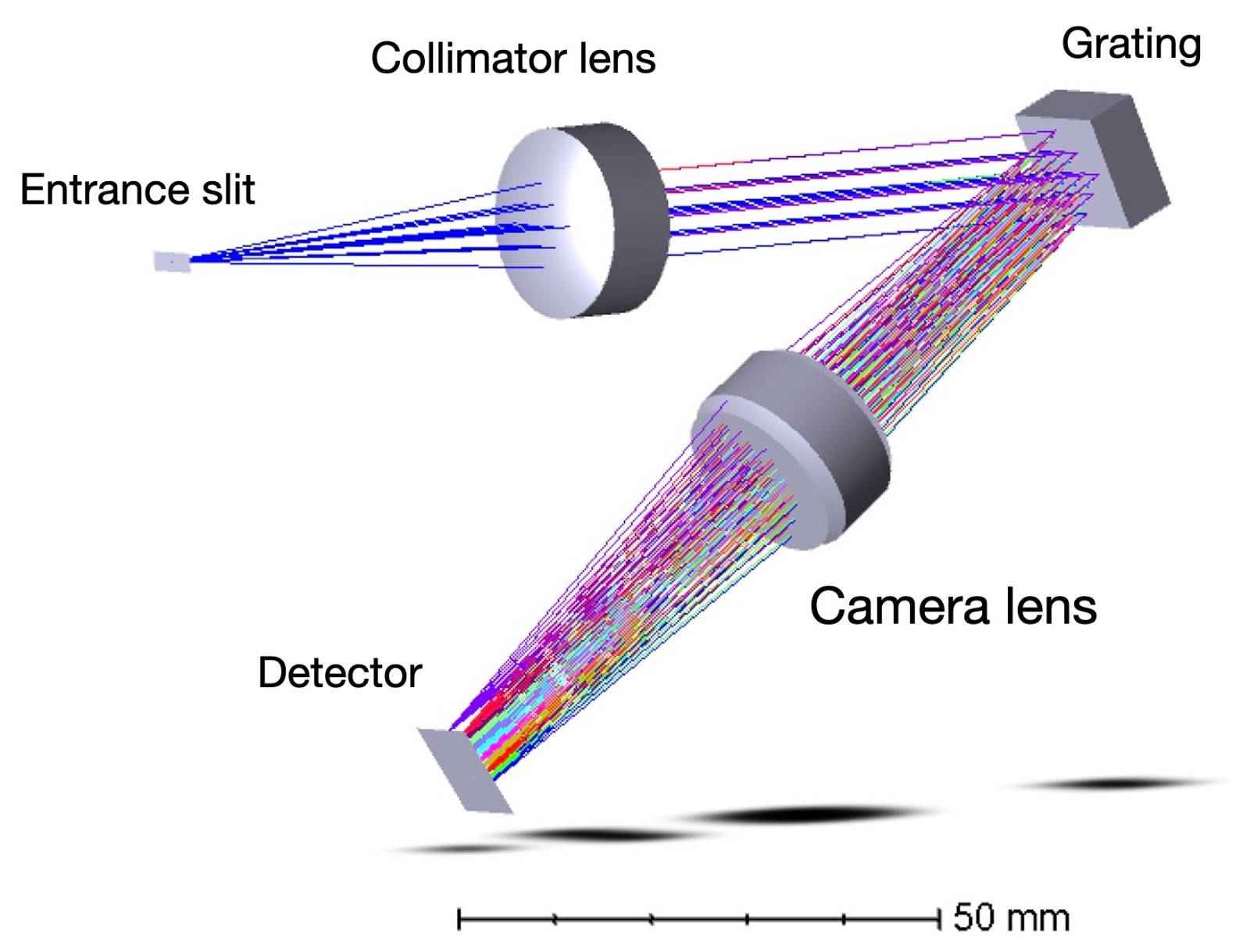
Four selectable slit widths are available. The 20 µm slit is the nominal configuration.
Plane reflection grating used for spectral dispersion.
Sampling on the IMX585 detector in the nominal visible configuration.
Near-infrared coverage can be obtained by changing the grating orientation and using the corresponding order filter.
Three-camera configuration
Each NORVIS unit uses three cameras with different functions. The science detector records the dispersed spectrum, while two imaging cameras provide information on the observed auroral structure and the position of the entrance slit on the sky.
Spectral acquisition
A cooled monochrome IMX585 detector records the two-dimensional spectrograph image from which the auroral spectrum is extracted.
Slit position
A dedicated camera images the slit plane and surrounding star field. These images can be used to determine the position and orientation of the spectrograph slit on the sky.
Auroral context
A wide-field camera records the morphology of the surrounding aurora during spectroscopic observations and provides contextual information for the measured spectrum.
Wavelength and relative response calibration
Daytime solar measurements are used for routine wavelength calibration. Sunlight reflected from a spectrally neutral target provides Fraunhofer absorption lines across the NORVIS spectral range, which are compared with a reference solar spectrum.
The same observations are used to determine the relative spectral response of each instrument. Calibration parameters are associated with individual NORVIS units and are applied during spectral reduction.
NORVIS spectra and context images
Representative observations from the February 2026 Skibotn campaign and the October 2026 observations at the Kjell Henriksen Observatory are available on the Data page.